Bracket Estimates, Rebuilt.
 jimmysnowmanDeck Building
TableCommander estimates a bracket for every Commander deck you build, using the official Commander Brackets framework as its rulebook. This week the estimator got its biggest overhaul since launch. Here is what changed and what it did to deck ratings across the site.
How the estimator works
The bracket system is, at its core, a set of card categories with thresholds: Game Changers, mass land denial, extra turns, tutors, two-card infinite combos. Our estimator mirrors that structure directly.
When we import card data (twice weekly, from Scryfall), every card is classified against each category: Game Changers come straight from WotC's official list, mass land denial from a curated list, and categories like tutors, fast mana, extra turns and free counterspells from the card's own rules text. Those classifications are stored per card, so estimating a deck is then just counting: how many of each category does the mainboard contain, and which bracket thresholds do those counts cross? A deck with no signals at all reads as Bracket 1; each signal it picks up can raise the floor, and the highest threshold crossed wins.
Estimates refresh for every deck daily, and immediately whenever you edit a deck. The categories below are exactly what changed in this overhaul.
Land ramp is not a tutor
The old detector counted any library search as a tutor. That meant Cultivate, Three Visits, Farseek and friends were quietly pushing green ramp decks up a bracket. The official bracket guidance excludes land-only searches, and now so do we: a search restricted to land cards counts as ramp, not a tutor. Mixed searches that can also find nonland cards still count.
Fast mana means fast mana
Three corrections here:
- Sol Ring is exempt. It is in virtually every Commander deck, so counting it shifted every deck's fast mana count up by one and quietly lowered the threshold for everyone.
- Scaling rocks are out. Everflowing Chalice and Astral Cornucopia produce nothing when cast for zero. They are ramp that scales, not acceleration.
- Mana filters are out. Chromatic Sphere costs a mana to use. Net zero is not fast.
What remains is the real list: Mana Crypt, Mox Opal, Lotus Petal, rituals, and the rest of the cards that actually let a deck explode ahead of the table.
Mass land denial, properly defined
The MLD list grew from 16 hand-picked cards to 99, sourced from the community-maintained Scryfall tagger and filtered to the official definition: cards that destroy, exile, bounce, tap-lock, or rewrite the mana of many lands without replacing them. That includes the soft locks (Winter Orb, Static Orb, Stasis, Back to Basics) and the mana-rewriters (Blood Moon, Harbinger of the Seas), which the official rules explicitly call out.
Two deliberate exclusions: planeswalkers whose only land destruction is their ultimate (a Liliana of the Veil ultimate is not mass land denial), and From the Ashes, which replaces the lands it destroys.
The result: about 300 decks running real mass land denial moved to Bracket 4.
| Bracket | Before | After | Change |
|---|---|---|---|
| 1 | 4,027 | 3,996 | -31 |
| 2 | 2,161 | 2,107 | -54 |
| 3 | 5,606 | 5,391 | -215 |
| 4 | 3,089 | 3,389 | +300 |
Two-card combos, at last
The biggest gap in the old estimator: it could not see combos. A Heliod and Walking Ballista deck with no tutors read as Bracket 1. The bracket system cares a lot about this; Bracket 2 decks are expected to run no two-card infinite combos at all, and Bracket 3 decks none that win in the early game.
The estimator checks every deck against the roughly 3,800 two-card, Commander-legal infinite combos in the Commander Spellbook database, refreshed weekly. A deck containing a two-card combo is at least Bracket 3. A combo that is cheap enough to assemble and fire early (both pieces plus execution within five mana, or curated as Ruthless by Spellbook) means Bracket 4. Mikaeus and Triskelion stays a Bracket 3 late-game combo; Thassa's Oracle and Demonic Consultation does not.
| Bracket | Before | After | Change |
|---|---|---|---|
| 1 | 3,997 | 3,447 | -550 |
| 2 | 2,107 | 1,574 | -533 |
| 3 | 5,391 | 5,277 | -114 |
| 4 | 3,389 | 4,604 | +1,215 |
The estimator now explains itself
The deck stats tab used to give you a bracket and a terse reason like "4 fast mana". It now shows, for every reason: the rule behind it, the threshold that applies, and the actual cards in your deck that triggered it. If your deck is a Bracket 3 and you want it to be a Bracket 2, the stats tab is now a checklist of exactly what to change.
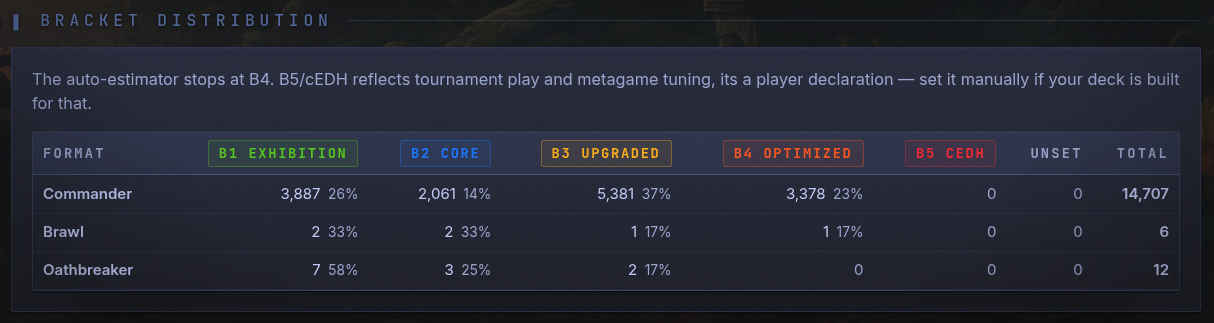
Why is there no Bracket 5?
The bracket system defines B4 and B5 by the same rule set: neither restricts cards beyond the banned list. What separates them is intent and metagame, not deck composition. A B5 deck is a B4 deck tuned to win in a specific competitive field, so the two can be card-for-card identical. That makes B5 impossible to derive from a decklist alone. Any list that reads as B5 is, on composition, simply B4. TableCommander therefore treats B4 as the estimator ceiling and exposes B5 as an explicit self-declaration rather than an inferred result.
The estimate is guidance for rule zero conversations, not a verdict; you can always set your deck's bracket yourself.
TableCommander is unofficial Fan Content permitted under the Fan Content Policy. Not approved or endorsed by Wizards. Combo data courtesy of Commander Spellbook.
No comments yet.